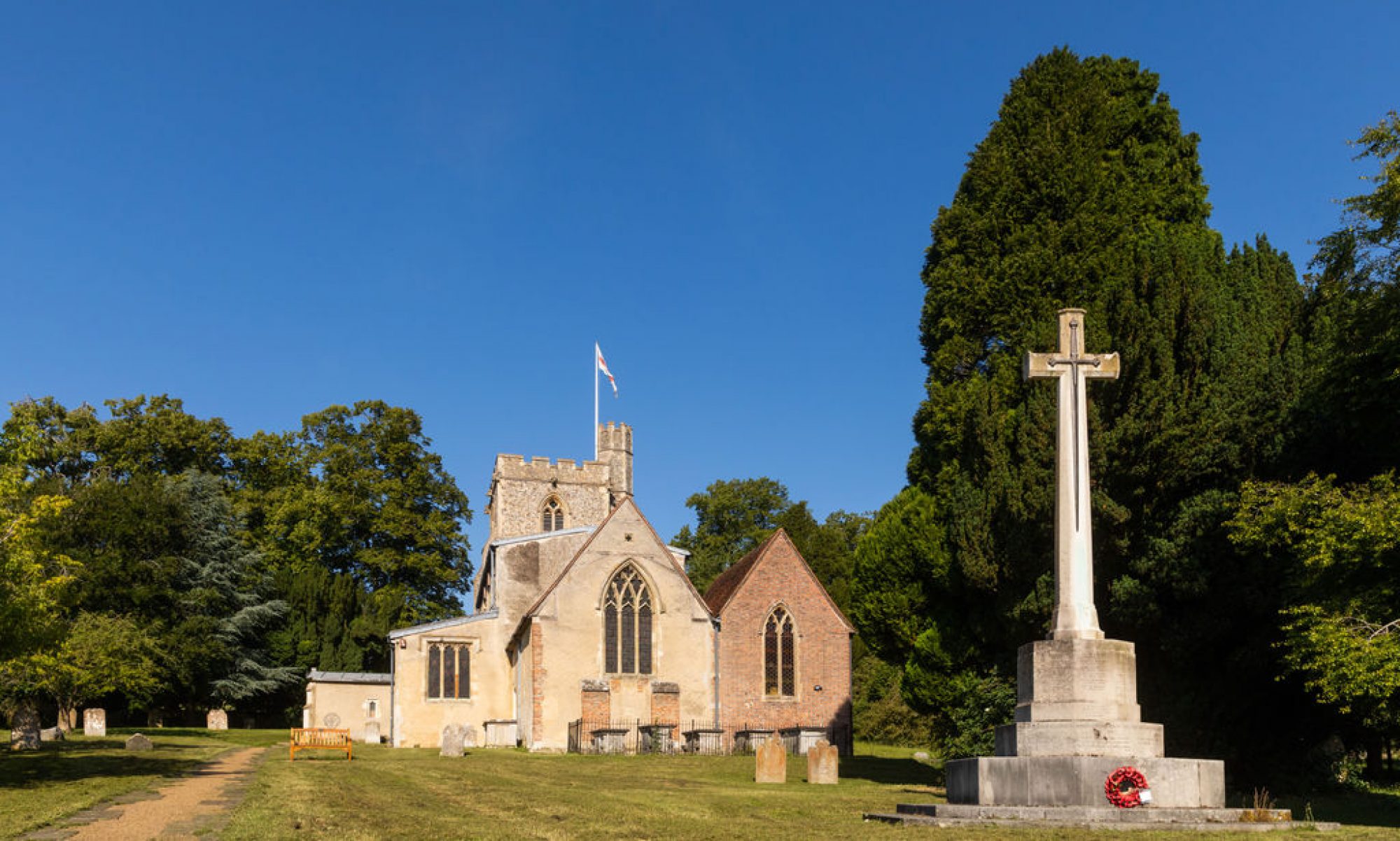
History of Great Gaddesden Church
A church has stood here since the dark ages, probably on a pre-Christian site, evident from the massive Hertfordshire Puddingstones in the foundations and the Roman brickwork. The oldest part of the current church is the Chancel, at the East end, which is dated as having been built between 1180 and 1220. The Chancel is in part built of Roman bricks, which some authorities believe to come from a Roman Villa near the site. The pre-Roman British Catuvellauni tribe, who had a well organised civic system, lived here, and the district was close to the city of Verulamium and was well occupied with farms and villas.
The main body of the church was progressively enlarged over the subsequent centuries, with the southern side aisle added in the mid 1200s, and the northern side aisle built in the 14th century. The tower and porch are 15th century. With the raising of the roof and the addition and alteration of windows, by about 1500 the church had assumed the form that it is today. The only major subsequent changes have been the construction of the Halsey Chapel in 1730, and the rebuilding of the tower in a wide ranging restoration of 1861.
Priests
A parish priest is recorded in the Domesday Book of 1086, and there is a record of the names of the priests or Rectors from 1255. In 1382, when the Prior of the Dominican Friary at King’s Langley became Rector, he appointed a resident Vicar. The dissolution of the monasteries in 1539 was administered here by Richard Yngworth, Bishop of Dover, and the last prior of Kings Langley. At this point William Halsey became Lay Rector, with the priest remaining as the Vicar. The list of Rectors names can be found at the back of the church, next to the Tower Room.
The Nave
As you enter from the porch you step down into the church; this is often a feature of churches dedicated to St John the Baptist, as Jesus Christ stepped down into the River Jordan to be baptised.
The main body of the church has two 13th century arcades dividing it from the adjoining side aisles. The left (north) has plain capitals, whilst the right has stiff leaf capitals. As you look east through the great Victorian chancel arch, which replaced an earlier Norman one, glance up to your right where you will see the door which originally led to the Rood Loft. This was demolished during the reformation, and formerly supported a large crucifix, known in old English as a rood.
The area above the arch was originally covered in a wall painting known as a “Doom”, showing the Crucifixion and Ressurection at the Last Day. Traces of this were discovered during the renewal of the roof in 1996. The East bay of the North aisle was built in the late 13th century as a chantry chapel, though we do not know for whom.
Much more recently, the beautiful oak pews were installed in 1976, having come from the old church at Shenley not far away. The rear sections of pews were removed in 2015 to create a flexible space at the back of the Church.
There are many memorials to see in the chancel, including, on the right of the north door, a slate monument to Stephen Munn, cook at the Golden Parsonage, whose legacy is still paid every year having been incorporated into Great Gaddesden Charities. The oak Madonna and child in the South Aisle comes from Oberammergau in Germany, site of the famous Passion Plays from 1633.
The Chancel
The East window depicts scenes from the life of St John the Baptist, and most of the monuments here are to members of the Halsey family, who have been Patrons of the Living and Lay Rectors since 1544. Notice though the grave of Dorothy Adby, whose legacy was given in the form of tea and sugar each year to eight widows in the parish. Today this legacy has also been incorporated into Great Gaddesden Charities.
On the left of the Altar is the monument to Thomas Plumer Halsey, his wife Frederica and second son Ethelbert, who were all drowned in the steamship Ercolano in the Mediterranian in 1854. His elder son Frederick, was not allowed to go on the fateful trip, having been caught smoking at school, and his diary of the time is stained with tears at the awful news.
On the right is a memorial to Captain Sir Thomas Halsey, who commanded the battleship HMS King George V during the Second World War, and a distant relative of the American Admiral Bull Halsey, who commanded the US pacific fleet at the same time. Sir Thomas’s wife Jean Brooke’s family were White Rajas of Sarawak. Higher up the wall is General Frederick Johnston of Hilton, with his five Christian names, who served in the Waterloo campaign.
The Halsey Chapel
Known as the Bone House, the chapel was built in 1730 and contains an interesting series of monuments to the Halsey family, including one by Flaxman and one believed to be by Rysbrack, whilst beneath the slab in the centre of the chapel is a crypt full of Halsey tombs. Look for the small brass plaque to Thomas Halsey, who emigrated to America in 1637 on the ship in which Oliver Cromwell was due to sail, before he was dissuaded by his friends. Thomas’s wife Phoebe was scalped by First Nation Americans in the vegetable patch.
The east window in the chapel came from the old Gaddesden Row Mission Church and was made by the famous wildlife artist Gordon Benningfield as a memorial to Molly Wood of the Hoo, whose son George married Joan Halsey.
The Tower
This originally had a famous “Hertfordshire Spike” which was lost during the 1861 restoration. Note the boards showing donations and charities and the gift of the clock from Gaddesden Place in 1955. The panelled screen came from Lane Farm in Gaddesden Row. The hatchment is that of Guy Marsden Halsey who died in 1990. Earlier hatchments appear in Buckler’s 19th century drawings of the church but have been lost.
The ringing chamber is on the first floor, and is home to a thriving company of bell ringers.